
Escape Room Success Calculator
Based on data from 200+ escape room venues worldwide, estimate your team's chance of escaping. The average success rate is only 30-40%!
Ever walked out of an escape room feeling like you just got schooled by a puzzle box? You’re not alone. Most people assume escape rooms are designed to be beaten - that if you’re smart enough, you’ll crack it in 60 minutes. But the truth? Most people fail escape rooms. Not because they’re dumb. Not because they didn’t try. But because the math is stacked against them.
What’s the real failure rate?
There’s no single global database tracking every escape room, but data from over 200 venues across North America, Europe, and Australia paints a clear picture. On average, about 60% to 70% of teams don’t escape. That means less than 1 in 3 teams solve the final puzzle before time runs out. Some high-difficulty rooms - think horror-themed or expert-level challenges - see failure rates above 85%. Even rooms labeled ‘medium’ often have success rates under 40%.
Why? Because escape rooms aren’t designed as games you win. They’re designed as experiences you *live*. The goal isn’t to make everyone succeed. It’s to make you feel the tension, the rush, the frustration - and maybe, just maybe, the triumph.
Why do teams fail? It’s not about smarts
People think failing means they’re not clever enough. But it’s rarely about IQ. It’s about teamwork, communication, and how you handle pressure.
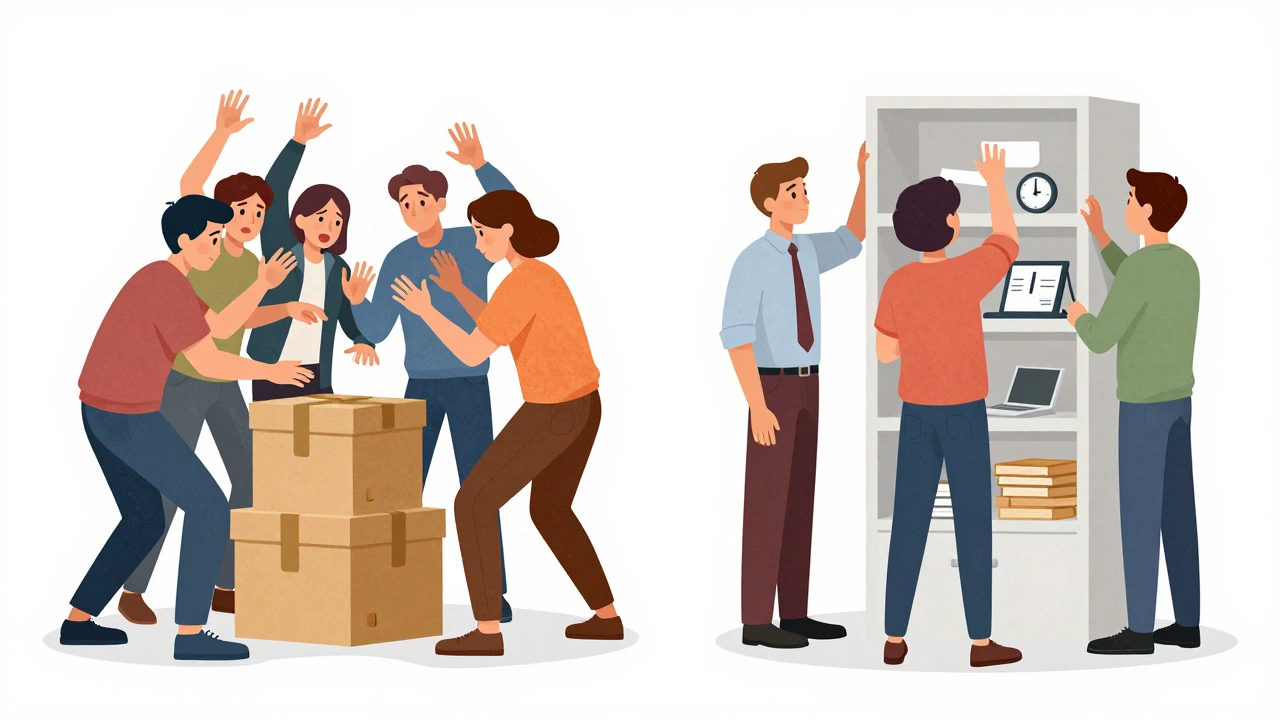
- Too many people in one room: Teams of 6+ often collapse under chaos. One person finds a key, shouts it out, and three others rush to check the same drawer. Meanwhile, the real clue sits untouched under a bookshelf.
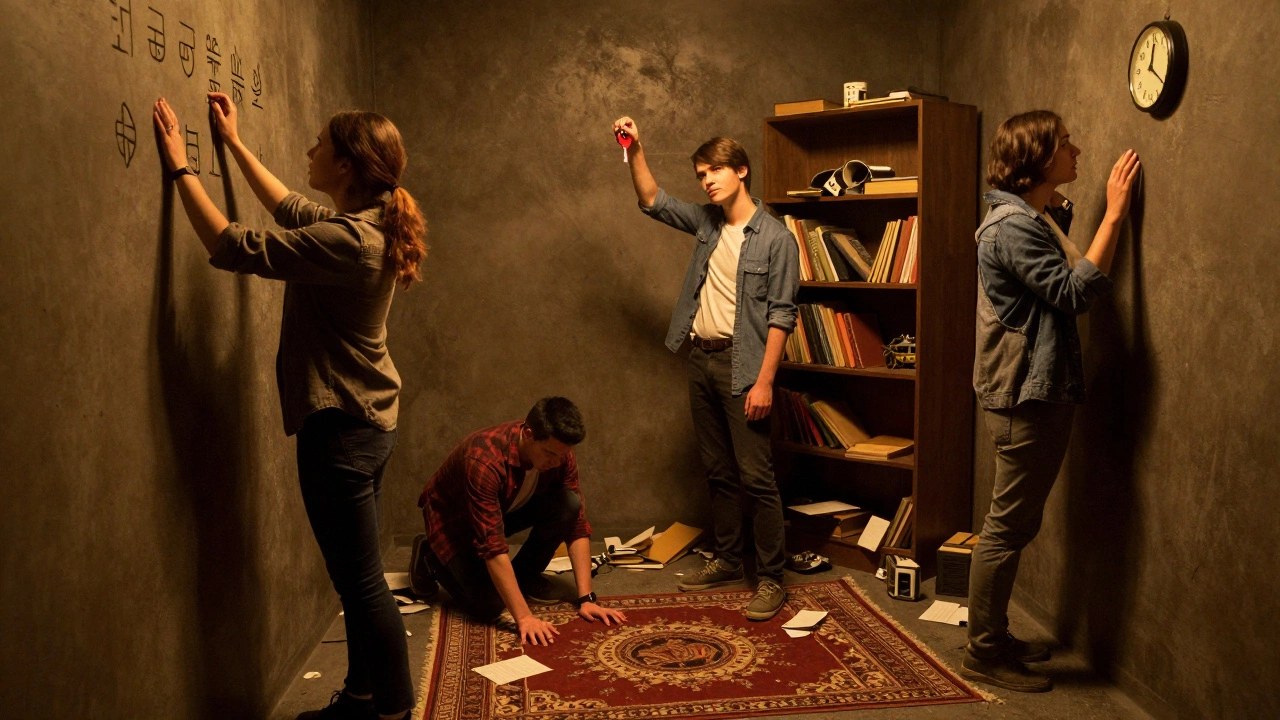
- Ignoring the environment: A painting? Just decor. A clock? Just for show. A weird symbol on the wall? Probably a code. But 70% of teams miss the obvious because they’re too focused on locked boxes.
- Not talking clearly: Saying “I found something red” doesn’t help. Saying “I found a red key with a number 7 carved into it - check the lock on the bookshelf” does. Most teams talk, but they don’t share.
- Getting stuck on one puzzle: Teams will spend 20 minutes trying to open a single lock while ignoring three other active puzzles. Time doesn’t wait. The room doesn’t care.
One Melbourne venue, Locked In, tracks every team’s performance. Their data shows that teams who split up early - two people on puzzles, two on searching, one on time management - had a 3x higher success rate than teams that huddled together.
What makes a room harder?
Not all escape rooms are created equal. Difficulty levels aren’t just marketing. They’re engineered.
Here’s what actually pushes failure rates up:
- Multi-step puzzles: If you need to find a number, use it to unlock a box, pull out a key, then insert it into a device that gives you a code - that’s a 4-step chain. One mistake, and the whole thing collapses.
- Hidden mechanisms: A drawer that only opens when you press a specific sequence of buttons… under a rug… while standing on a pressure plate. No one thinks to check that.
- Red herrings: Fake keys, fake codes, fake journals. These aren’t mistakes - they’re traps. And they work. About 65% of failed teams waste time on at least one red herring.
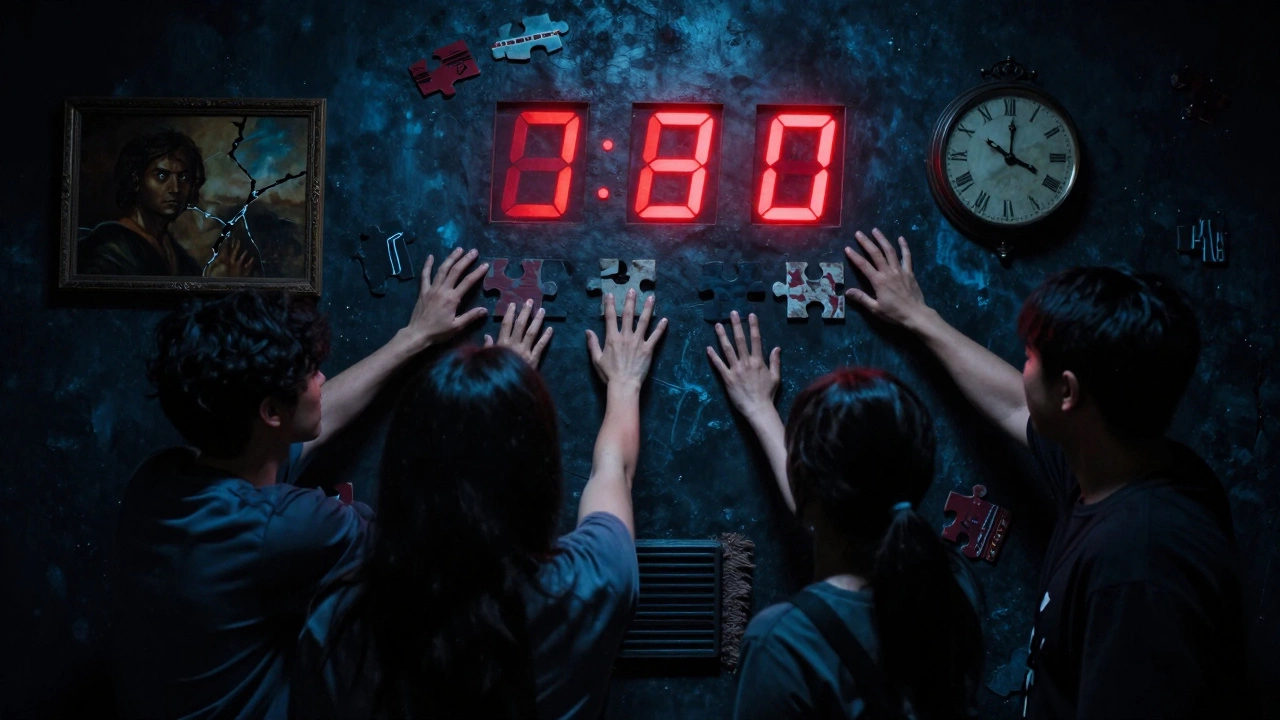
- Time pressure: The 60-minute clock isn’t arbitrary. It’s based on the average time it takes a well-coordinated team to solve the room. That means if you’re slow, you’re already behind.
Rooms like The Bank Heist in Sydney and Asylum in Melbourne have success rates below 20%. These aren’t just hard - they’re designed to break your rhythm. They force you to rethink how you solve problems.
Who actually succeeds?
It’s not the geniuses. It’s not the puzzle experts. It’s the teams that:
- Assign roles: One person watches the clock. One person calls out discoveries. One person checks the walls. One person handles physical objects.
- Communicate like soldiers: “I’m on the bookshelf. Found a torn note. Doesn’t make sense yet.” Not “Look at this weird thing.”
- Move fast: If a puzzle doesn’t click in 3 minutes, they walk away. They come back later. Sometimes the answer’s obvious once you’ve seen the rest of the room.
- Trust the process: They don’t panic. They don’t yell. They don’t blame. They just keep moving.
At Escape Melbourne, they let teams record their gameplay. They found that the most successful teams spent 80% of their time actively communicating - not just talking, but listening and building on each other’s ideas.
Can you improve your odds?
Yes. And it’s not about practice. It’s about strategy.
Here’s what actually works:
- Book a room with 3-4 people. Five is the max. Six? You’re asking for chaos.
- Don’t rush in. Spend the first 60 seconds scanning the room. Look for patterns, colors, numbers, symbols. Don’t touch anything yet.
- Split up immediately. Two people search, two people check puzzles. Rotate every 5 minutes.
- Call out everything. Even if it seems useless. “There’s a clock with Roman numerals.” “The painting has a crack on the left.” You never know what connects.
- Use the hint system. Most venues give 2-3 hints. Use them early. Waiting until you’re desperate means you’ve already lost 15 minutes.
- Don’t fixate. If a puzzle isn’t clicking, walk away. Go check the door you haven’t touched. Sometimes the solution is right next to it.
Teams that follow these five steps see their success rate jump from under 30% to over 60%. It’s not magic. It’s just better teamwork.
Is failing even a bad thing?
Here’s the twist: Failing an escape room doesn’t mean you lost. It means you had a real experience.
Think about it. How often in life do you get to be completely immersed? No phones. No distractions. Just you, your team, and a ticking clock? Most people never feel that kind of pressure - and never get that kind of adrenaline rush.
One team in Perth failed their room three times. Each time, they came back. The fourth time? They escaped. But what they said afterward? “We didn’t care about winning. We just loved how we figured each other out.”
Escape rooms aren’t about winning. They’re about connection. About pressure. About learning how to work with others under stress. The room doesn’t care if you escape. But you? You’ll remember how you felt when you tried.
So next time you walk out without the key? Don’t feel bad. You didn’t fail. You just didn’t finish. And that’s okay. Because the next time? You’ll be ready.
What percentage of people escape escape rooms?
On average, between 30% and 40% of teams successfully escape. This varies by difficulty level - beginner rooms may have success rates near 50%, while expert rooms often see fewer than 20% escape. Data from venues across Australia, the U.S., and Europe consistently shows that 60-70% of teams don’t make it out in time.
Are escape rooms designed to be beaten?
No, they’re not designed to be easily beaten. They’re designed to be challenging, immersive, and memorable. While some rooms are easier than others, most are calibrated so that only well-coordinated teams succeed. The goal isn’t to let everyone win - it’s to create a shared experience that pushes people to communicate, think under pressure, and work together.
Do escape room companies track failure rates?
Yes, most serious escape room operators track success rates for every room. They use this data to adjust puzzle difficulty, improve hint systems, and refine room design. Some even publish anonymized stats on their websites. For example, Melbourne’s Locked In reports that teams using clear communication and early role assignment have a success rate over 60%, compared to under 30% for teams that don’t.
Is it better to play with friends or strangers?
Friends usually do better - but only if they already know how to communicate. Teams with close friends often fall into old habits: one person takes charge, others stay quiet. Strangers, surprisingly, sometimes work better because they start from scratch. They ask more questions, explain their thinking, and don’t assume everyone knows what they mean. The key isn’t who you play with - it’s how you work together.
Can you get better at escape rooms?
Absolutely. The biggest improvement comes from learning how to communicate under pressure. Practice doesn’t mean playing more rooms - it means playing smarter. Focus on assigning roles, calling out clues clearly, and not getting stuck on one puzzle. Teams that follow basic teamwork rules see success rates double after just two or three games.