
Air Adventure Finder
Not sure which sky-high experience is right for you? Tell us what you're looking for and we'll suggest the perfect match!
Recommended Activity
Your ideal aerial experience is based on your preferences!
Quick Comparison Guide
Skydiving
The gold standard for high-adrenaline thrills.
Paragliding
A meditative, long-distance glide with nature.
Hot Air Ballooning
Serene, romantic, and visually stunning.
Ziplining
Accessible speed through the canopy.
Bungee Jumping
The ultimate test of psychological courage.
Quick Takeaways
- Skydiving is the gold standard for high-adrenaline thrills.
- Paragliding offers a meditative, long-distance glide.
- Hot Air Ballooning is ideal for sightseeing and relaxation.
- Ziplining provides a low-barrier entry to aerial speed.
- Bungee Jumping focuses on the intense sensation of the fall.
The Ultimate Rush: Skydiving
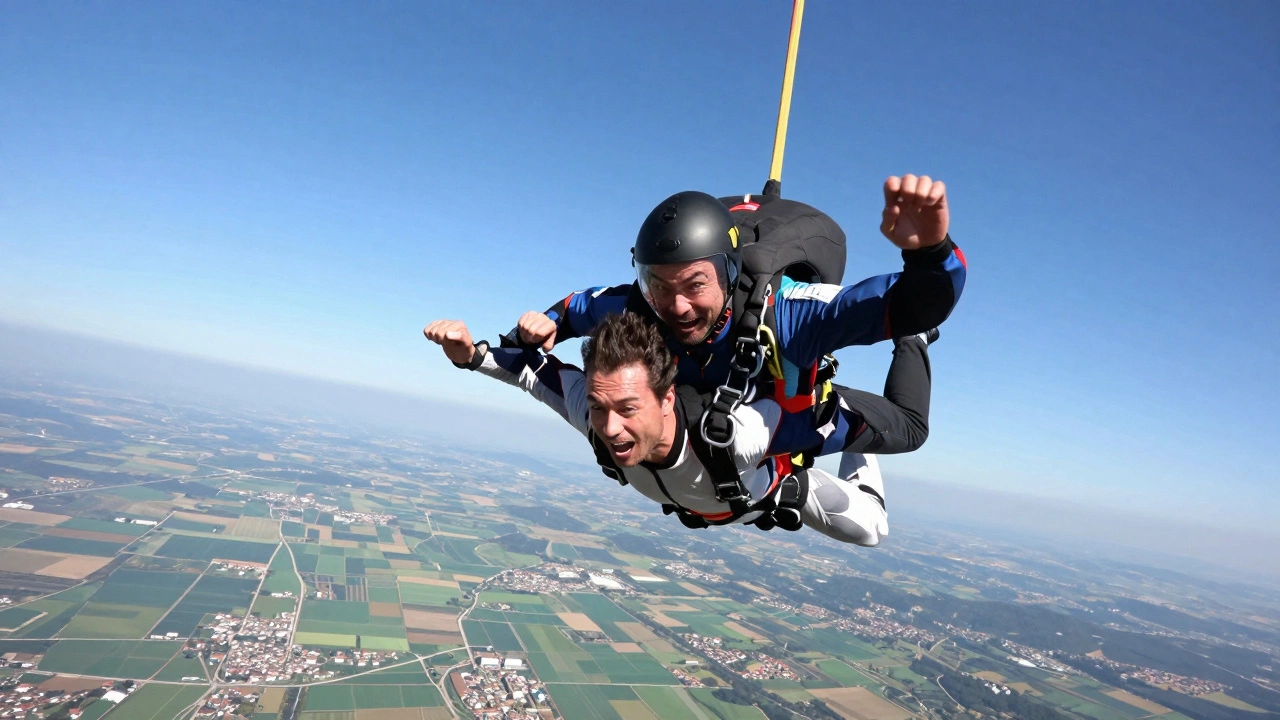
If you want to know what it feels like to be a human stone falling toward the earth, Skydiving is a recreational activity where a person jumps from an aircraft and falls toward the ground at high speeds before deploying a parachute. It's not just about the fall; it's about the mental shift that happens when you step out of a plane at 13,000 feet. The initial freefall lasts about 60 seconds, where you hit terminal velocity-roughly 120 mph-which creates a sensory overload that makes it impossible to think about anything else.
For most people, the first jump is a "tandem" experience. This means you're strapped to a certified instructor who handles the gear and the pull-cord. It's the safest way to try it because you don't need any prior training. Once the Parachute opens, the chaos disappears and is replaced by a peaceful glide back to the landing zone. If you get hooked, you can go through an Accelerated Freefall (AFF) course to learn how to jump solo, which transforms the hobby from a one-time bucket list item into a technical skill.
Gliding with the Wind: Paragliding
While skydiving is about the descent, Paragliding is all about the flight. Paragliding is a foot-launched gliding aircraft with no rigid primary structure. You essentially launch yourself off a hill or a mountain using a wing made of high-strength fabric. Unlike a parachute, which is designed to slow you down, a paraglider is designed to keep you up.
The magic here is in the thermals-columns of rising warm air. A skilled pilot can find these invisible elevators to climb thousands of feet, staying airborne for hours. It's a much more intimate experience than flying in a plane because there's no cockpit and no engine noise. You just hear the wind whistling past your helmet. Because it's a recreational activities in air option that relies on nature, the experience changes entirely based on the weather and the terrain, making every flight feel like a new discovery.
The Peaceful Perspective: Hot Air Ballooning
Not every aerial activity needs to feel like a stunt from an action movie. Hot Air Ballooning is the act of flying in a craft consisting of a large envelope filled with heated air. It is the oldest form of human flight and remains one of the most romantic and serene ways to experience the sky. Since the balloon moves with the wind, there is virtually no breeze felt by the passengers, creating an eerie, floating sensation.
The physics are simple: heating the air inside the envelope makes it less dense than the surrounding air, causing the basket to lift. Most flights happen at sunrise or sunset when the air is most stable. It's less about the "thrill" and more about the scale. Seeing a city, a vineyard, or a national park from 2,000 feet without the vibration of an engine provides a sense of perspective that's almost meditative. It's often paired with a champagne toast upon landing, a tradition that dates back to the early days of French ballooning.

High-Speed Transit: Ziplining
For those who aren't ready to jump out of a plane but want the feeling of flying, Ziplining is the perfect bridge. Ziplining involves sliding down a stainless-steel cable suspended between two high points using a pulley system. It's more of a "controlled' air activity, usually found in canopy tours through rainforests or mountain resorts. You get the speed and the height, but with the security of knowing you're attached to a heavy-duty cable.
The appeal of ziplining is the accessibility. You don't need a license or a week of training. You just put on a harness and a helmet and go. Modern courses often include "super-zips" that can reach speeds of over 60 mph, giving you a genuine rush of wind and a bird's-eye view of the forest floor. It's a great way to combine an aerial experience with a nature walk, as most courses are built around ecological education.
The Vertical Drop: Bungee Jumping
Finally, we have Bungee Jumping. While some argue it's more of a "gravity" activity, the experience happens entirely in the air. Bungee jumping is a jump from a high structure while connected to a large elastic cord. It's a concentrated burst of terror and euphoria. The goal isn't to fly or glide, but to experience the physiological shock of a sudden drop followed by a violent, springy rebound.
The psychological aspect of bungee jumping is what draws people in. It's a direct confrontation with the fear of falling. Whether you're jumping off a bridge in New Zealand or a crane in a city center, the sensation of weightlessness during the drop is unique. The elastic cord is engineered to stretch and retract based on the jumper's weight, ensuring that you don't hit the ground but do get a few exhilarating bounces before being lowered safely.
| Activity | Intensity | Skill Level | Primary Appeal | Typical Duration |
|---|---|---|---|---|
| Skydiving | Extreme | Low (Tandem) / High (Solo) | Adrenaline & Speed | 15-30 Minutes |
| Paragliding | Moderate | Medium | Freedom & Gliding | 1-3 Hours |
| Hot Air Ballooning | Low | Low (Passenger) | Peace & Scenery | 1-2 Hours |
| Ziplining | Moderate | Low | Speed & Accessibility | 30-90 Minutes |
| Bungee Jumping | Extreme | Low | Shock & Weightlessness | 5-10 Minutes |

Choosing Your Air Adventure
Picking the right activity depends on what you're actually looking for. If you're trying to conquer a deep-seated fear, bungee jumping or skydiving provides the most immediate psychological reward. If you want to disconnect from the noise of the world and actually feel the air moving around you, paragliding is the way to go. For those traveling with family or looking for a romantic date, a hot air balloon ride is far more appropriate than a 10,000-foot drop.
Safety is the common thread across all these activities. Every one of these sports relies on rigorous equipment checks and certified professionals. Whether it's the AAD (Automatic Activation Device) in a skydiver's rig or the reinforced cables of a zipline, the engineering is designed to make the "dangerous" part of the experience a controlled illusion. When choosing an operator, always look for certifications from recognized bodies like the USPA (United States Parachute Association) or local aviation authorities to ensure you're in good hands.
Do I need to be in peak physical shape to try skydiving?
Not necessarily. For a tandem jump, you don't need to be an athlete. As long as you are within the weight limits of the equipment and don't have serious heart or back issues, most people can handle it. The instructor does the heavy lifting; you just need to stay relaxed and follow the signals.
Is paragliding safer than skydiving?
Safety is relative. Skydiving has incredibly redundant safety systems (like reserve chutes), but the speeds are higher. Paragliding is generally slower and more controlled, but it is more dependent on unpredictable wind shifts. Both are very safe when managed by certified professionals.
What happens if the wind is too strong for a hot air balloon?
Balloons are very sensitive to wind. If the gusts are too high, pilots will cancel the flight for safety. This is why ballooning is often scheduled for the early morning, as the air is typically coolest and calmest then.
Can I try ziplining if I have a fear of heights?
Yes! Ziplining is actually a great way to "exposure therapy" your way out of a fear of heights. Because you are securely harnessed and the movement is linear and predictable, it feels much safer than standing on a ledge.
How often do bungee cords need to be replaced?
Bungee cords have a strict limit on the number of jumps they can perform before the elasticity degrades. Professional operators track every single jump on a cord and retire them long before they reach their theoretical breaking point to ensure maximum safety.
What to Do Now
If you're feeling the itch to get airborne, start by identifying your "fear threshold." If you're a total beginner, book a ziplining tour-it's low risk and high reward. If you've already done that, look for a local paragliding school that offers "intro flights." If you want to completely flip your perspective on life, go find a drop zone and book a tandem skydive. Just remember: check the weather, check the certifications, and most importantly, bring a camera, because you'll want proof that you actually did it.